Branching Out by Bonsai | Ep. 13: Lydia Fern on Building Bonsai
Welcome to Branching Out by Bonsai, the podcast where marketing gets measured, myths get busted, and acronyms get explained. No filler, just the good stuff. Let's get into it.
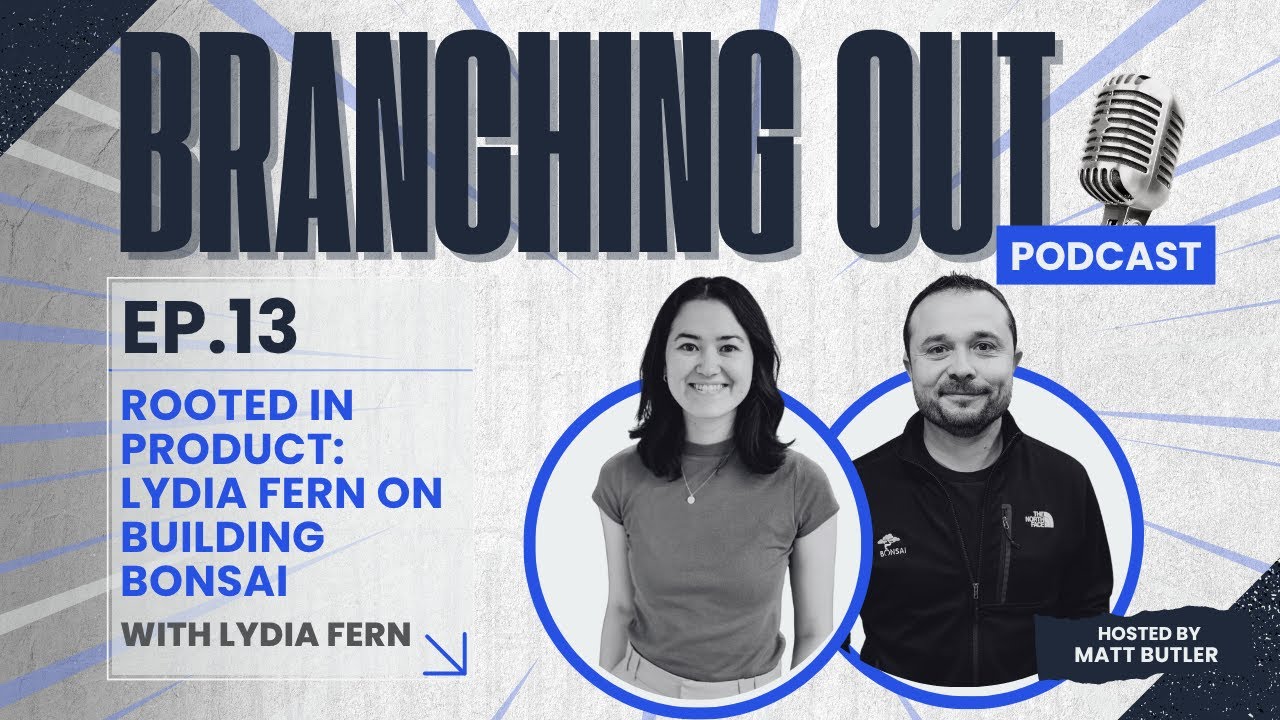
To listen to the full episode, check out: https://www.youtube.com/watch?v=IIJWM5N0sGk
Hi everybody. Welcome back to Branching Out. This episode is a special one. We're going to talk to Lydia Fern. You might not yet know who Lydia is, but I have a feeling you're going to hear a lot about her. She is our current Director of Engineering and Analytics here at Bonsai. Lydia is also the most talented person I've ever worked with or worked for. I've worked in this industry for over 20 years and I've been really privileged to learn from and work alongside some of the most talented people in technology. There's not much more I can say.
We had a great chat. I kind of surprised Lydia with some of the extent of our discussions. You'll hear a little bit about her perspective on learning, on listening, on technology, and a little bit about Bonsai's product and all the things we're working on. She's a treasure and I'm really looking forward to sharing this episode out with everybody. Enjoy.
Matt: Thank you, Lydia. So, I asked you to do a podcast with me during our one-on-one time. Thank you for letting me do that. I had a little Zoolander joke in here. I don't know if you like Zoolander.
Lydia Fern: I've never seen it.
Matt: You've never seen Zoolander? Okay, so that's good. You should definitely check that out. We'll get back to movies and shows in a second, but there's this funny line from Derek Zoolander. It's introspective, but I'll turn it to you. Who are you?.
Lydia: I'm Lydia. Who am I?. I work at Bonsai. I lead engineering at Bonsai.
Matt: You're a Wildcat.
Lydia: I'm a Wildcat. I went to Northwestern. I'm a mechanical engineer. I still say that even though I have a degree in mechanical engineering and I worked as a mechanical engineer for almost 5 years. So, I still feel like that's in me.
Matt: I'm not sure I've met any mechanical engineers who are ever not mechanical engineers.
Lydia: When you study engineering in undergrad, I feel like it's actually really common to not end up doing it. I have lots of friends who studied engineering and they all end up doing consulting or something in data. But mechanical engineering, I would say, is the one where it is most common for you to actually end up working in manufacturing or something.
Matt: Why do you think that is?. As someone who didn't get their undergrad in one of the engineering fields, I hear all you Mechs go on and on about what engineers are better, or Mechs are better, or electrical... What's that all about and what's your take on all that?.
Lydia: Well, when I was in undergrad, there is a specific engineering degree called Industrial Engineering. It's probably what I should have studied. It's more about studying technological systems and you study a lot of coding. It would have served me better, but instead of IE standing for Industrial Engineering, we called it "Imaginary Engineering".
I think mechanical engineers specifically have this emphasis on the physical, tangible product of your work, and that's what made me actually want to go into it. The idea that your work would be completely intangible and only exist in ones and zeros is kind of....
Matt: Now that you work in a lot of data and computer systems... Follow-up question: Are computer engineers, engineers?.
Lydia: What is engineering?. I'm still not even sure I know what a data engineer is. So, yeah, computer engineers are engineers.
Matt: Well, I agree. I was just very curious because you have a charming way of getting to an incisive point. I was just trying to coax some dirt out of you there about talking smack, but I know that you're too good for that.
Lydia: Well, and I can't talk smack about Imaginary Engineers because I am one now. So, there you go. And it's better.
Matt: I do know that most of the "imaginary engineers" and real engineers are good at learning how to not just make stuff and build stuff, but solve puzzles. I know you've talked a lot about how much you enjoy solving puzzles. What's one of your favorite unsolved puzzles?.
Lydia: I don't know if this is considered unsolved, but did you ever see the Netflix documentary The Staircase?.
Matt: I've heard of it.
Lydia: It's about a woman who falls down the stairs and dies, and it's a question of whether or not her husband pushed her or not.
Matt: Oh, yes.
Lydia: I don't even remember the ending, what ended up happening to him. I think he was convicted, and then I think he appealed, and then I think there was a mistrial. So, I'm not sure if he has been for sure convicted or not, but I love stuff like that.
Matt: I didn't watch The Staircase, but I do have some memory of watching the old Netflix show about Robert Durst. That was less of a puzzle, more just super interesting psychoanalysis, and then the puzzle—which everyone already knew the answer to—ends up being solved at the end publicly. So maybe the puzzle is: why are people the way they are?.
Lydia: That is exactly the beauty of that one.
Matt: Love that you love solving puzzles. You're also really great at building stuff, whether it be mechanical stuff or computer stuff. How do you approach building stuff from scratch?. You've now been involved in a few projects here where we've gone from zero to one. Do you think about it at all?.
Lydia: If I'm building something from scratch... I'm trying to think if there has been anything truly from scratch where I had nothing to go off of. My first question is always: is there something that exists that can serve as a jumping-off point?. I start here and transform it in some way, or use some part of it. I think I'm usually trying not to go from scratch. I'm trying to find something that already exists that I can build off of.
In building stuff here at Bonsai, I've learned more about... you've talked to me a lot over the years about "use fake data" or "based on a true story". Building almost from the front-to-back, of what should this thing look like to the user. It doesn't matter if it doesn't actually work yet or is powered by real data, but getting that right and then working backwards from there.
Matt: A better way I would say it—to not incriminate myself with the data engineers—is I do think it's really interesting: if something could work and is it right are two very different things. A lot of times you spin your wheels trying to get it right, or asking "how could we work on getting this right?" when we don't even know if it would work. So, it can be freeing if you're like, "You don't need to even worry if this is right yet. We don't know if we can do it". It feels good in my heart that you remember a few of the things I've recommended.
Thinking back to when you started with us at Bonsai, what was the least favorite part?. You had come from Woodward, right?. Talk a little about that and has it changed?.
Lydia: I had been at Woodward for almost five years, and I felt like I had finally got to the point in my career there where I was interacting with a lot of different people in a lot of meetings, asking questions, being asked questions. I felt like I'd finally gotten to the point where if I was asking someone for something... I knew exactly how to interpret what they said. I knew if they were giving me a BS answer, or I knew not to take certain things at face value. I felt like I knew what was going on.
Coming to Bonsai, being in a completely different industry in a different role, I was back to ground zero. Someone could be saying to me on a call "this is not possible" or "I need this" and I had no context. It's tough to interpret what anyone's really saying sometimes when you're new to a space. "This is what I'm hearing," but it turns out that's not what we're really talking about. I would hear a lot of that from you. We'd be on a call together and afterward you'd be like, "Yeah, people say this, but when they say this they actually mean this," or "They don't know what they're talking about".
Matt: Trust me, you mastered this craft in a very short amount of time. Thinking back to pre-Bonsai days, serving analytically, consulting, advising—that's super hard. You talk to tons of people and you're trying to figure out "what are we really talking about here?". You would leave fixated on "I think we should talk about this" and realize this team didn't want to solve that problem, they want to solve that problem, but we didn't talk about that problem and no one let me in on that.
Over time I began to realize that it wasn't just me. No one has the information. Half the time it's just understanding that the people on the other end are just as... they've been brought in with their half-version of what they think we're doing, too. A lot of times any kind of friction or conflict about what the next step should be is less to do with them not wanting to believe you, and just that they don't understand why they don't understand. You don't understand why you don't understand.
We're more than excited to have you here helping us build the next few years at Bonsai. My first impressions of those years were: one, you're really great at what you do on the engineering side, but just even your example of willing to jump in and be put into a position where there was no way to prepare you—and we didn't do a good job of preparing you—and just running with it is so admirable. I think we have a bunch of people here who do a good job of that, but you are certainly a model for them.
Recently we've launched a tool that helps facilitate and automate a lot of things we've done from an advisory perspective. What are you liking about it?. What are you excited about regarding what we might do with it?.
Lydia: I love the product and I love working on the product. Basically, the measurement stuff that we've done ad hoc and in a custom way in the past is now not only standard in the front end, but the way that we build it is a lot more automated and we can scale so much more.
It's been really fun. In the past, it was like, "Someone wants this answer," so I have to spend 30 hours building something that's going to be used once and never again. Now it's like, I can do that and then it can actually go into a platform and be used by everyone. Some of the "Mechy" in me likes seeing it—it's not physically tangible, but it's visually tangible. I remember when I wrote the code and built the Looker dashboard for the Match Market testing that exists on the internet now.
Matt: We will have a new website—I think that's actually today. We have taken on some new partners and we announced our Seed Round at Bonsai. How does that affect you and what do you think about when you think about all that stuff?.
Lydia: The Seed Round is super exciting. Just in terms of knowing that we're going to exist and grow over the next four years. I think that was not always something I took for granted. Just the fact that we will have the time and the resources ahead of us to be able to keep working on the product and making it better. It's crazy how we built so much in basically a year with no funding. So it's like, wow, what could we do with three years with funding? That is really exciting.
Matt: I'll speak for myself on this: going to growth mode is exciting. With this capability and our platform and some of our early adopters and customers, we've gotten to see multiple of them actually improve their business in a very material, real, tangible way. Because of how we're thinking about putting together this product in the company, not that many of us actually have lived through other scenarios.
There are a lot of really interesting and smart computer scientists and technologists who've built tools in marketing, and there's a lot you can do. It is kind of a shame that so much of it typically ends up being a great idea that people use, but it doesn't actually end up improving things. We have this naive optimism... it's great. We have to really protect what we decide to do here if we're going to ensure that what we do continues to move a bottom line of a business, because that's the standard.
Thinking about you leading us on the technical side, there's a certain standard of work that we do and how we think about what we build that just doesn't really exist elsewhere. Things are usually about "does the light turn green and is the thing on?" not "is it working?". We just have a totally different definition of "working" here. I'm very proud of that.
Eventually, you have to do not just "based on a real story," but actually have a real story. Working with lots of engineering teams and multiple stakeholders, what did you learn from doing that?. What should we all learn about how to do that?.
Lydia: I think listening is important. Approaching conversations with various people with a level of humility and wanting to understand who this person is, what they need, what they want, and what their pain points are. Approaching it from a level of humility and listening gains you a lot.
One, I think you actually gain information that's useful for you to make decisions or respond to them. But I think it also just helps people like you, and it makes people feel like they want to work with you and you're not just coming to bulldoze someone. Listening and humility—I think that applies to everyone. Engineers are people too, Matt.
Matt: I think this is breaking news. So, in the earlier years when you first came to Bonsai, we had you speak at an event at one of our bigger clients. You knocked it out of the park. I think I might have asked, "Wow, it was your first time doing that kind of presentation. How did you do so well? Did you practice?". And you said something to the effect of, "Oh, you know, I was just watching you guys talk," and you mentioned listening to us. So one, why did you lie to us?. Two, obviously there's something in this listening... what does listening mean to you?.
Lydia: I didn't lie. Maybe I was being a suck-up. I was still very new at this company. I think with communication—whether I'm speaking to a group of people or just Slacking or emailing—a lot of it is thinking about: how would I want to receive this information?. How can I receive information in a way that would make sense to me and be easy to digest?. Like the Golden Rule. And having examples, both good and bad, of being communicated to in a way that was helpful or not. And maybe being "judgmental"—constantly asking, "how would I do this differently?" or "how can I learn from this?".
Matt: That's important. The Golden Rule is an amazing rule. "Judgmental" has a bad connotation, but the good connotation is that you were actually thinking about what that person is saying and contextualizing. Literally evaluating. Judging is different than stereotyping, where I've made my mind up about this and I'm not listening anymore. I think you're right to call it out—to be thinking about this and putting in the context of: How do I feel about that? Is this right? Is this wrong? What do I want to know more about to get on board with what I'm hearing?. That definitely is active listening.
Take us to the next two or three years here. Where are you taking us, Lydia?.
Lydia: In the next few years, I want to continuously automate and make things faster. Both in the sense of our ability to onboard someone and stand up measurement for them, but also reducing the time it takes for our clients to then be able to actually put that into action. Instead of them seeing an answer in a dashboard, can that automatically adjust their bidding, their spending, or whatever messaging they're sending out?.
And then I also want us to... I think we're always walking this fine line between "it's a platform, it's standard" and "everything has to be custom and different for every client". I want us to make it easier and easier for people who want to use this platform to make it their own and make it feel really personal and custom, even though it is a standard platform.
Matt: I don't know what you would say is your favorite current thing. I think it's the greatest trick we're pulling with our platform. It is custom, but that level of "it's really actually custom". Some of the coolest feedback I've ever gotten about what we've done so far is that there are certain things the platform does that defy belief on the customization. They literally do not understand; it could not possibly be a platform.
Lydia: Are you not going to even name the feature? I'm so curious to know.
Matt: It's not that secret. I might mention that our tool works for B2C companies across different types of verticals. I might show somebody a commercial airline, and then an automotive company, and then people selling water bottles or phones. They'll hear me say it and it'll make sense, but then they'll see a specific example and it'll be something very small—like one-one-millionth of the actual backend complexity—and they'll be like, "Oh, look at that one. That's really cool. That must have taken months". There's absolutely no framework for someone to even think about how you couldn't possibly build a platform that could do that. That's the thing that I'm very excited about right now.
Lydia: Me too.
Matt: All right, enough about Bonsai. Let's talk about you. One day you told me that you're very... you love sound. What should we know about sound? Why would we care about it?.
Lydia: I went through some weird phase where I was learning about sound. I have a vivid memory of my 10th-grade physics class, learning about the human ear and how it works, and just being like, "What?". The process of you asking me that question and hearing the question... it's a physical process of sound waves hitting my eardrum in a certain way, and then my brain can perceive that as a word and think about it. It's crazy.
Matt: Can you give us a fun fact about sound?.
Lydia: The only fun fact I can think of is something that was a hoax. There was this hoax article going around that they had a clay pot that had been made hundreds of years ago. The hoax was that they were like, "Oh yeah, if we take this clay pot and spin it at a certain speed and hit it with certain things, you can hear the sound of the background noise of what was happening in the room when the pot was being made, because speaking makes a sound wave that hit the soft clay". It was not true, but that's not that different from how records work.
Matt: Tell us more.
Lydia: I think records are some combination of physical, mechanical grooves that are machined into the record, and then there are some electrical processes happening.
Matt: The fact that you can have a physical object that when you put it on something and you send electricity into it, Adele's voice will come out... I mean, you are right to be amazed by that.
Lydia: Isn't that... I don't know how it works. To me, that's my favorite unsolved puzzle. It's been solved by other people, but it has not been solved by me.
Matt: We'll put that in the comments. That'll be our first user mail: How do records work?. It's another example of things we've all figured out. In our day jobs, we basically work on this thing that the prevailing point of view says, "Of course you couldn't figure that out". So it gives me hope. Maybe we'll make a little Bonsai record player one day.
Let's talk shows. We both love Nathan Fielder. Why do you love The Rehearsal so much?.
Lydia: I very much enjoy the season. I think for season 1, the thing that really made me love it was: you get the first episode, it's already a ridiculous premise, and you're like, "Okay, great. I'm going to get seven more of those". And then episode 2 starts and you're like, "Oh, there's something else going on here. There's something bigger here". It's already ridiculous, but you think you figured it out and then it takes a left turn. I love that. And he's just funny. He walks that line of reality and surrealism.
Matt: You're not alone. I think you hit on the key thing: not everyone finds this style funny, but I find it enormously funny. I like it because it's so aggressively trying to make those people who would find that funny laugh, while just having no respect for the place it should stay and just going against comedy norms.
Absurdism is one way to think of it. I think of it more as this absolute uncaged, directionless ambition that I find so fascinating. You're like, "What in the world are we doing here?" and then it gets escalated to another level. He's just going for it until someone says stop or "you're under arrest". But it's not shock-tragic-comedy humor. I like the naked ambition of the gall it would take to make it.
I kind of ambushed you by recording a podcast as our one-on-one. So, as my annual review, I'm hoping you will meet with me one-on-one again after doing this and you won't hold that too much against me. Are there any closing thoughts you have?.
Lydia: We're building something—we have built something and we're continuing to build something—that I think is one of a kind. As we continue to try to really walk that line of "standardize things so that it can scale" but also "feel custom for everyone" and ensuring that the results that you'd see in your business are also very specific to your goals... I think maybe that's what sets us apart a little bit. We're trying to do both well, and I think so far we are, and I hope we continue to.
Matt: There are a lot of people out there who would benefit a lot by getting a chance to work with you.
Lydia: You want to get to me, you got to go through him.
Matt: In all honesty, I think what we're building is an awesome start. We're all very grateful that you're here to help us continue to grow together. So, thank you so much, Lydia. I promise you are now dismissed. Thus ends the embarrassment of me putting you in front of the camera.
Lydia: I'm sweating.
Matt: It's all good. It's just the office. We'll turn off these stage lights. Great job, Lydia. Thanks.
Lydia: Thank you.